
I Just Wanted to Learn AI.
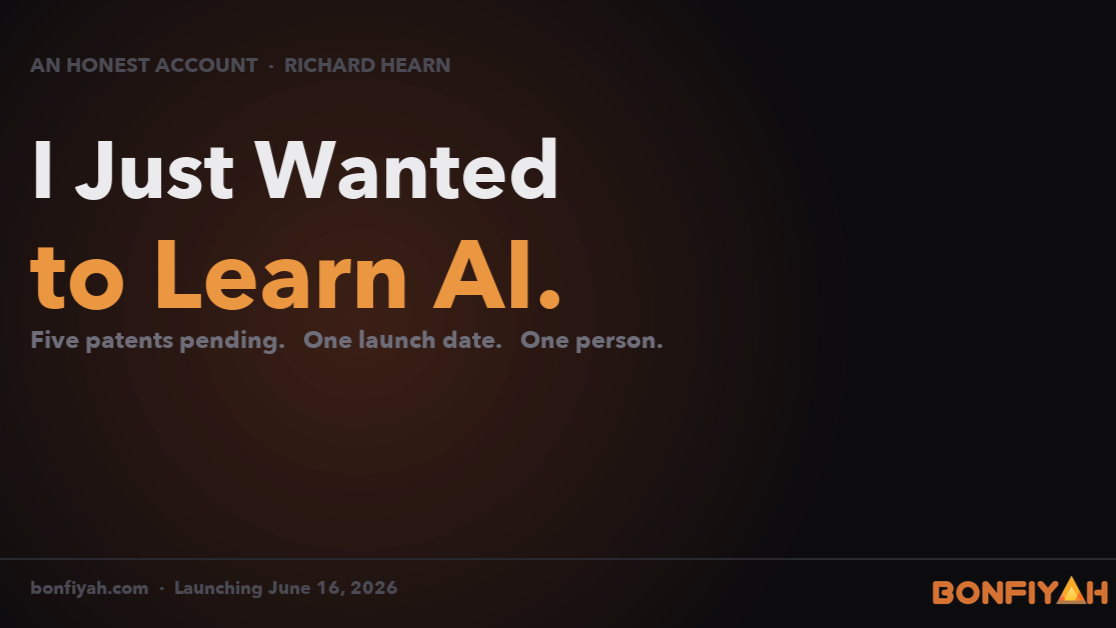
All I ever wanted to do was learn AI. That was it. Not build a startup. Not disrupt a market. Just understand this thing that everyone around me kept talking about.
I’m not new to AI — I’ve been working with it since 2016, when I ran Watson business applications at IBM. But the pace of change lately is different. I wanted to stay close to it.
It started with ChatGPT. Simple chat, basic prompts. Then I got curious about something more personal. I wondered what would happen if I built a custom GPT trained on all of it. So I did. It worked better than I expected. You can still interact with it at RichardGPT.ai.
Then I found Claude. And somewhere in that transition, I discovered CoWork.
I’ll be honest — I didn’t know what CoWork was at first. I wasn’t sure how it fit. So I did what I always do when I don’t understand something: I just asked it directly. I asked CoWork how to use CoWork. That conversation became part of my daily routine, and it eventually led me to Claude Code. YouTube helped. But mostly I learned Claude by talking to Claude.
Here’s the thing: I am not a developer. I have never written a line of code in my life. So the first few weeks were uncomfortable. Then it started to snowball.
The Original Idea Was Too Big
My actual goal when this started was embarrassingly ambitious. I wanted to build something that would record everyday human conversations and, eventually, turn them into a film. Real people. Real stories. Captured in real time.
Big, hairy, audacious? Yes.
But I’ve never believed in ceilings. That’s been both my superpower and my liability throughout my career.
So I trimmed. I focused. And what came out of that process was Bonfiyah.
I Built It for Myself First
The early version was simple: record the conversations I was actually having. Not Zoom calls, not meetings with bots — the ones across a kitchen table, in a parking lot, in a hallway after something important just happened. Let AI do something useful with them.
Getting it to work for me, on my own devices, took a few weeks. That part was genuinely fun.
Then I started adding things. Record online meetings. Record doctor visits. Share transcripts and AI summaries. Build speaker insights across recordings. Then more. Then more.
Eventually I started showing results to a few people. Not pitching — just sharing what it was doing for me. Better context on old conversations. Better memory for what was actually decided. Better follow-through on things that mattered.
Nearly everyone who saw it said the same thing: can I get a copy?
That’s When Things Got Real
Building an app for yourself is one thing.
Building one for other people — with real security, privacy compliance, Apple App Store requirements, scalability, patent considerations, and infrastructure that doesn’t fall over — is roughly a hundred times harder. And I say that as someone who has spent 25 years building enterprise technology for some of the largest companies in the world.
I knew what complicated looked like. I still underestimated this.
Then came the administration layer. That turned out to be more work than the app itself. And when that was done, I had to build marketing infrastructure from scratch. That part is still catching up — which is why you haven’t heard much noise about this until now.
Claude Code became less of a shortcut and more of a necessity. Not because I couldn’t think through the problems, but because the speed of iteration it enables is unlike anything I’ve experienced in 25 years. The architecture, the security model, the Apple compliance requirements, the payment infrastructure — all of it had to be right, and it had to move fast.
What started as a few-week project turned into months of deep work. Rewarding, frustrating, humbling, satisfying work. Sometimes all four in the same afternoon.
This Past Weekend, I Submitted to the Apple App Store
Five patents pending. An app that runs natively on iPhone, iPad, and Mac — synced over iCloud. Speaker identification. Real-time transcription. AI that reasons across months of recorded conversations. A privacy model I’m genuinely proud of: your audio is deleted from our servers within seven days, and we never train AI on your conversations.
100% me. No co-founder. No engineering team. Just one person who wanted to learn AI and kept pulling the thread.
Our launch date is June 16.
(Update, July 2026: we made it — Bonfiyah is live on the App Store, and every account now starts with 14 days of the full product, free.)
What I Know About Myself
I lack many gifts. I have a few.
The one that seems to carry me through — in business and in life — is that I genuinely lack any expectation of impossibility. I don’t think I was born with it. I think I just stopped paying attention to the part of my brain that says something can’t be done.
Sometimes that works against me. I’ve started things that couldn’t be finished. Aimed at targets that moved. Underestimated what it actually takes to get something right for everyone, not just for yourself.
But sometimes — like right now — it’s the only thing that gets you across the finish line.
If any of this sounds useful to you, go to bonfiyah.com and download it — it’s live on the App Store, and every account starts with a 14-day free trial of Pro + Pro AI, no card.
June 16 is aggressive. But anything worth doing is worth being aggressive about.
What might turn out to be an overnight success — or a complete flop — is the result of 25 years of living at the edge of what’s possible in enterprise technology. I built this the same way I’ve built everything: by believing the ceiling was higher than everyone else thought it was.
I can’t wait to find out how it lands.
Richard Hearn is the founder of Bonfiyah, an Apple-native app for capturing and reasoning across the conversations that matter. It’s live on the App Store, with a 14-day free trial of the full product on every account.