
The King You Never Chose
Society keeps replaying chess
In 1997 I sat in a room at Procter & Gamble while six directors and vice presidents explained that I was making a grave mistake.
I was 24 and I had resigned with no other job lined up. I had been tagged as a fast tracker, and I had been working with my VP on a move into brand management, one of the most coveted jobs in the world at the time.
Their case was simple. Stay for the next 35 or 40 years and retire with three or four million dollars. Then came the line I still remember.
“Nobody quits Procter.”
They were not villains, and nothing they told me was false. At that point the company had never had a layoff, and plenty of people there had been with the company 20 and even 40 years. If I stayed I would be promoted, and then promoted again. What I could not have put into words at 24 is that every one of those promotions was a move inside a game somebody else had written.
I told the whole story years ago. The best picture I have found for that room since is a chess board.
Society keeps replaying chess. That is the thought I cannot put down. Companies and families do it as surely as governments do. The same positions get filled and the same games get played, mostly by people who never noticed they had taken up a position at all.
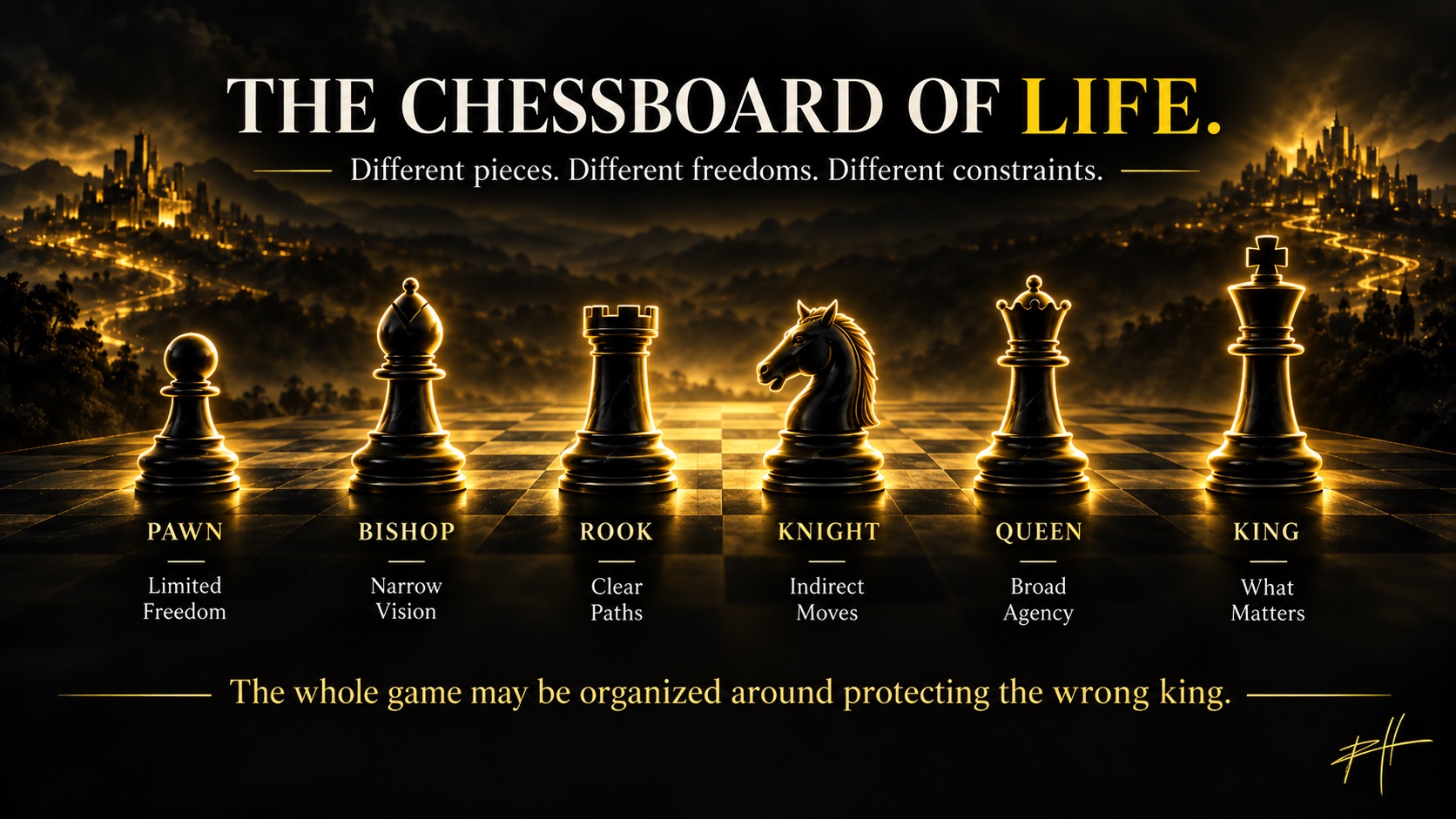
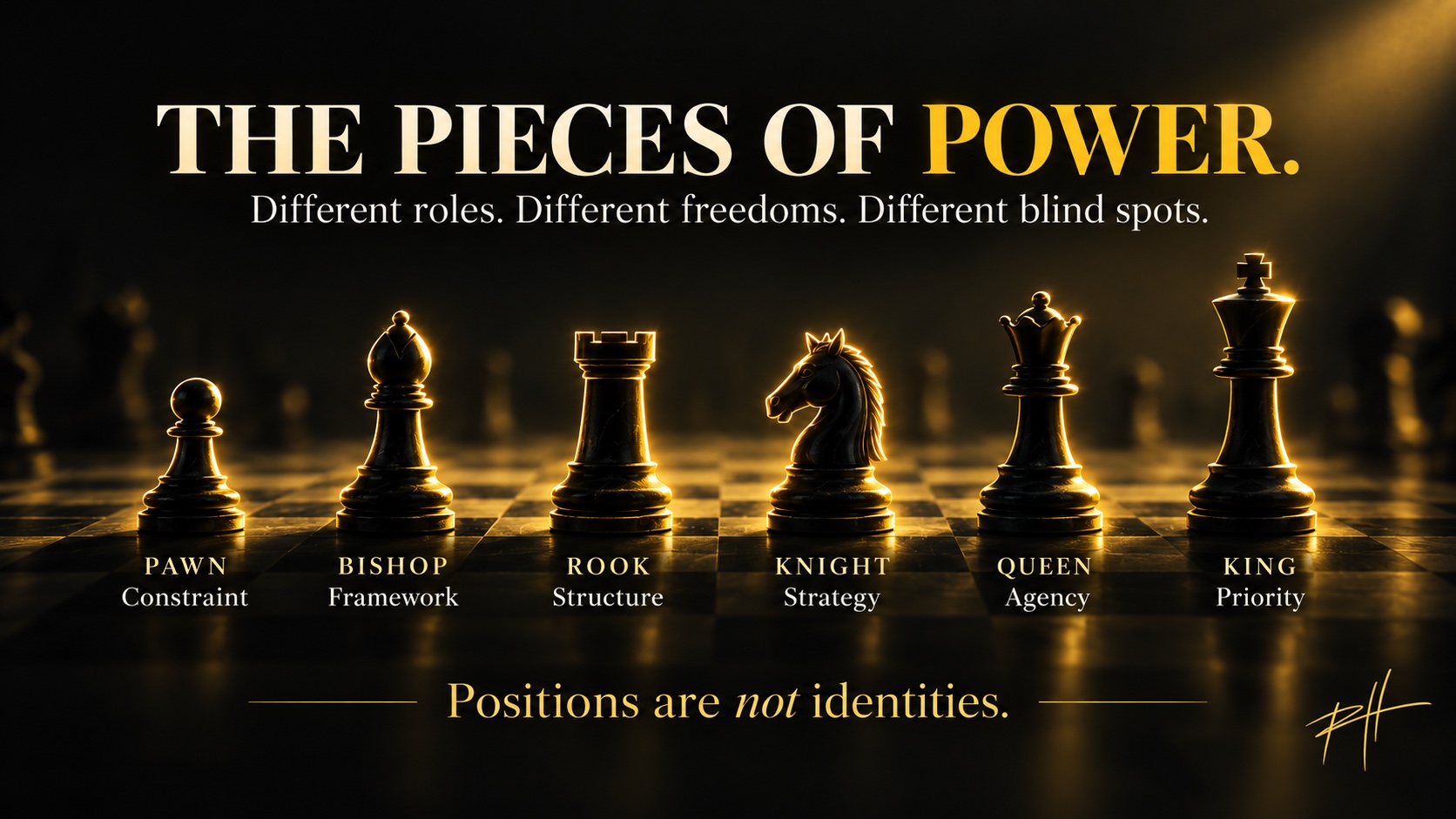
The lazy version of this idea says some people are pawns and some people are kings. I think that version is wrong, and a little ugly. The pieces work far better as kinds of power than as grades of human being. A position hands you certain freedoms, certain obligations, certain protections and certain blind spots.
The mistake is confusing the position someone occupies with who they are.
None of this is science. It is a way of looking, and it earns its keep only if it shows you something you were missing. Here is how I would set up the board.
The pawn cannot go back
A pawn only moves forward. It can never retreat. If it makes it all the way across the board it is promoted, and it can become a queen, a rook, a bishop or a knight. It can never become a king.
I use the pawn for anyone whose responsibilities are larger than their control over the situation. The brilliant engineer building out a strategy she did not choose. The employee absorbing a decision made three levels above him. Pawn describes where they stand in that moment and says nothing about their intelligence or their worth.
How much discretion does this person actually have?
Promotion is the revealing part. A person can pick up extraordinary capability and influence and still never be asked what the whole arrangement exists to protect. That was the offer in the room at Procter. Moving up inside a game and writing the game are different achievements.
Do not read pawn as irrelevant, either. Half the pieces on the board are pawns, and any serious player will tell you that the way they stand together decides what kind of game can be played at all. One person with little discretion is easy to ignore. A row of them is the shape of the whole position.
The pawn is also the only piece with somewhere to get to. Through the middle of the game its work is mostly blocking: holding ground, closing lines, shielding what stands behind it. Its objective is the far side of the board, where it can become any power piece except the king, and it nearly always becomes a queen.
Here is what I find most interesting. Only pawns can be promoted. A rook, a bishop and a knight stay exactly what they were anointed at the start, for the whole game, however well they play. The piece with the least power is the only one on the board that can become something else.
So every pawn is a power player that has not arrived yet. That is worth remembering about the people at the bottom of any org chart. Some of them are holding the line, and some of them are already on their way across.
The bishop never sees half the board
A bishop moves on the diagonal, as far as it likes, and it spends the entire game on the color it started on. A bishop that begins on a light square will never touch a dark one. For that piece, half the board does not exist.
That is expertise. The lawyer sees obligations and liability. The economist sees incentives. The engineer sees what can be built.
I am an investor, so I see returns, and I have to remind myself that this is my diagonal and that it is only a diagonal.
Each of those ways of seeing reaches things the others miss, and the depth is real. The danger is mistaking the squares you can reach for the whole board. You can hear it happen in a single sentence.
The bishop says “that makes no sense.” The accurate version is “that makes no sense inside the framework I am using.”
I am not arguing against expertise. I am arguing for knowing where it ends, because any strong way of seeing is also a strong way of not seeing.
Chess has a quiet answer to the problem. You start with two bishops, one on each color, and good players hate giving up the pair, because together they cover everything. That is the best argument I know for putting people who see differently in the same room, and then listening to the one on the other color.
The rook delivers every Tuesday
A rook moves in straight lines, along the ranks and files, as far as it wants. It cannot jump over anything. It starts the game boxed into a corner behind its own pawns, and its best work comes late, once the board has opened up.
To me the rook is organized capacity: systems, infrastructure, procedures, the finance function, the distribution network. It is the institution that keeps running after the charismatic leader has left the building.
Can we do this every time, or did we do it once?
The knight may spot the opening and the queen may rally everyone to it. The rook is what delivers on the promise every Tuesday. Its virtue is reliability and its weakness is rigidity, since a rook with a blocked path does nothing at all.
We hand most of the glory to the visionary and the person at the top. Keeping something running is a separate achievement from imagining it, and I would argue far more companies die for lack of the first than for lack of the second.
The knight takes the route nobody else can
The knight moves in an L, and it is the only piece on the board that can jump over the others. It also lands on the opposite color every single time it moves. The bishop never leaves its color. The knight cannot stay on one.
That is the person who reaches an outcome by a route the other pieces cannot use. The entrepreneur who reframes a market. The negotiator who changes the structure of the deal instead of haggling over the price.
Why are we assuming we have to come at this head on?
I have some history with this piece. At Purdue I was told I could not earn a mechanical engineering degree and complete a business minor at the same time, because the courses did not line up.
I asked whether the recommended curriculum was required. It was not. Everybody simply followed it.
So I mapped the required courses and their prerequisites myself, took them out of order, and finished one semester late with the engineering degree and every business course I was after. I did not break a single rule.
That is the part of the knight people miss. Its move is as legal as any other on the board, which makes it a picture of creative strategy and a poor picture of rebellion. Not every unconventional move is smart, and not every restriction is imaginary. The skill is finding the legal route everybody else overlooked.
The knight’s weakness is confusing surprise with value. Being hard to predict is no accomplishment. The move still has to win something.
The queen can do the most, and the game is still not about her
The queen combines the rook and the bishop. Any direction, any distance. She cannot jump and she cannot move like a knight, but nothing else on the board comes close to her range.
She is broad practical agency, the ability to connect information, resources, relationships and execution. In a company this is the operating leader who can fix the customer problem, persuade the board, recruit the person you cannot do without and move money to where it is needed. Often it is not the person with the grandest title.
What needs to happen, and how do we get it done?
Here is the distinction I find most revealing in the whole analogy. The piece that can do the most is not the piece the game is organized to protect.
Bobby Fischer was 13 when he gave up his queen in what is still called the Game of the Century, and won. You can lose your queen and still win. Lose your king and the game is over.
So a person can hold enormous operating power and still be serving an objective they never chose. If you are the one everybody calls when something has to get done, that sentence is worth sitting with.
The king is whatever must not be lost
Castling aside, the king moves one square at a time. It is close to the weakest piece on the board. And yet the entire game is decided by whether the king is trapped. Capturing the most powerful piece wins you nothing by itself.
That is the central paradox. The king’s standing has nothing to do with what it can do. It comes from the rules making its survival the whole point.
Which is why I would not always look for a person. The king can be an interest or an objective, whatever everything else is arranged around. In a business it might be the company’s survival, the controlling owner’s interests or the founder’s reputation. In a public institution it might be the mission, or the institution’s own standing.
Some of those are worth protecting. Some become destructive. To find the king in any system, ask one question.
When things get difficult, what is everything else expected to sacrifice itself to preserve?
I invest in companies for a living, and I would trade most of the org charts I have been handed for a straight answer to that. At my own firm we wrote ours down: the first job is not to lose the money. Everything else on our board, the clever pieces included, exists to protect that. Writing it down is how you make sure you chose it.
The queen is the capacity to act. The king is the definition of what must not be lost.
Nobody has to be playing
This is the part of the idea that interests me most, because of one word: unknowingly.
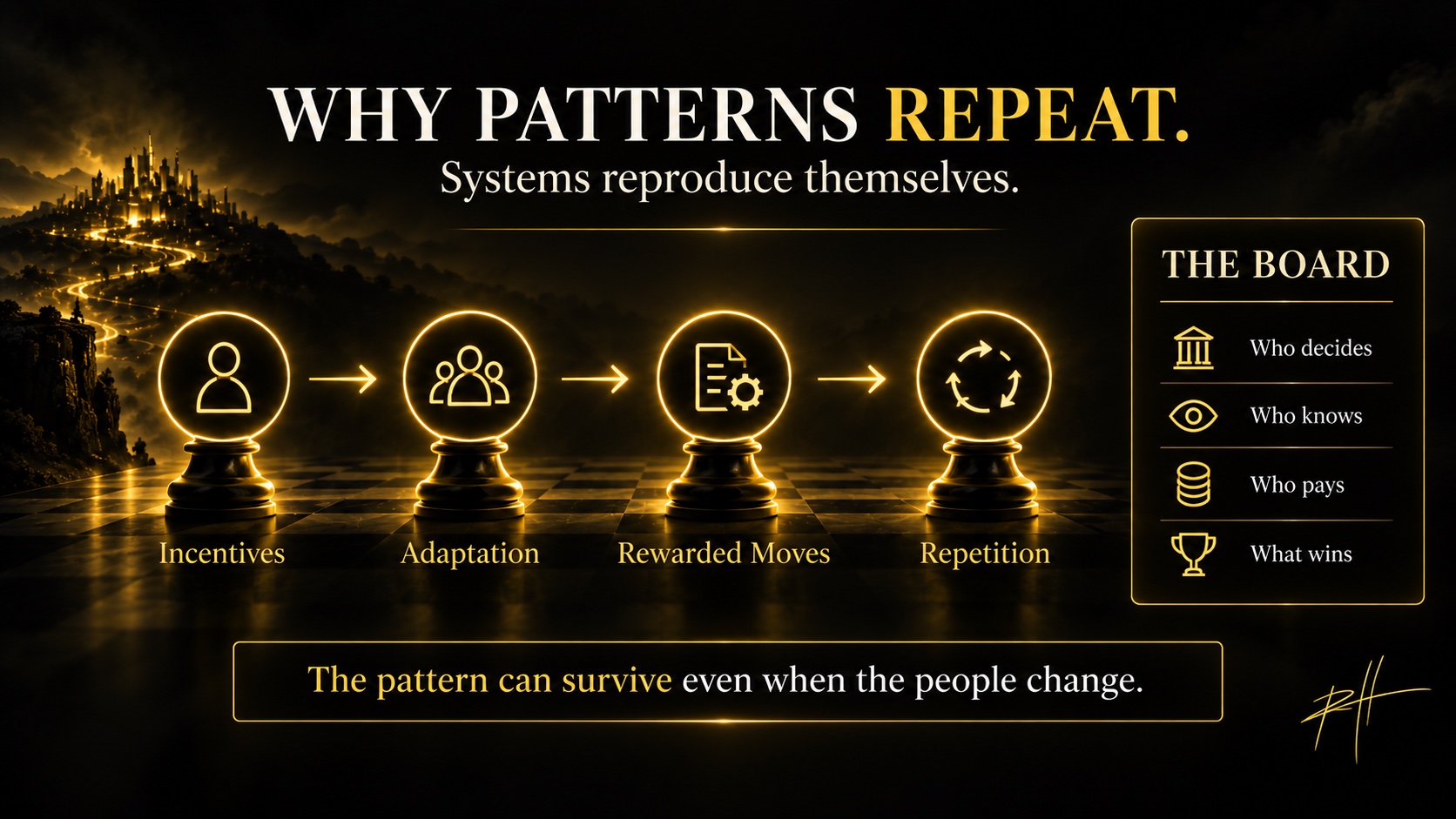
There is a difference between acting unconsciously and consciously chasing a local goal without seeing the larger pattern your actions help reproduce. Most of us are doing the second. We are making sensible moves.
The economist Douglass North, who shared the Nobel in 1993, defined institutions as “the rules of the game in a society.” He meant the formal rules and the informal ones together: the customs, the taboos, the codes of conduct. The way I read him, recurring behavior is never explained by personalities alone. The rules around the people matter as much as the people.
Picture a company that says it values candor. When employees disagree with the founder, they lose access. When they reassure the founder, they get responsibility and promotion. Now let that run for a few years.
The ambitious employee learns to reassure. The specialist learns to explain why the preferred decision is defensible. The effective operator learns to execute instead of challenge. The ones who will not play along leave.
Nobody ever called a meeting and said, let’s build a court around the founder.
Replace every person and keep the incentives, and new people walk into the room and discover that the same moves get rewarded.
That does not describe every organization. It needs no hidden grandmaster, and it does not rule out deliberate manipulation in a particular case. It simply explains how a pattern can repeat without anybody designing it.
The question underneath is psychological. At what point does “this is what my position rewards” turn into “this is who I am”? A learned role starts to feel like an identity. A rule you never questioned starts to feel like a law of nature.
The board matters more than the pieces
So include the board itself. By the board I mean the arrangements that decide which moves are possible: who gets to decide, who is allowed to refuse, who receives information, who bears the consequences and what counts as success.
Take two companies with equally talented people. In one, disagreement is punished and information is hoarded. In the other, disagreement is allowed and everyone knows who decides what.
They will behave very differently, and it would be a mistake to explain that by saying one hired pawns and the other hired queens. The boards permit different moves.
The reflex when a team disappoints is to replace people. Sometimes that is right. But if the board stays the same, do not be surprised when the new hire is making the old moves within a year. There is a better question for anyone who runs anything than “how do I find better pieces?”
What kind of behavior does the board I have built make possible?
The queen was not always the queen
Chess carries its own proof of this. The game is generally traced to India around the sixth century, roughly 1,500 years ago. The piece that stands beside the king began life as a counselor, and for more than nine hundred years it could move only one square diagonally. It was one of the weakest pieces on the board.
The sweeping queen I described earlier arrived with a set of European rule changes in the late 1400s, a little over five hundred years ago. The bishop got its long diagonal in the same reform. The wood did not change. People changed what the piece was allowed to do.
Even a chess piece’s power was never an eternal truth. It was assigned, inherited and eventually changed.
That adds a layer to everything above. If the strongest piece in the game owes its power to a rule somebody rewrote, then the way power is arranged in a company or a family is no law of nature either. Somebody set it up that way once, and it can be set up differently.
Where the metaphor breaks
The dangerous reading of all this is “I am the player, and everyone else is a piece.” Real people have purposes of their own. Their loyalty is not ownership, and their cooperation does not make them instruments.
Nor does anyone hold one role everywhere. The same person is a knight when spotting an opportunity, a rook when building the operation that delivers it, and a bishop when reading events through a belief they hold deeply. You are probably a different piece at work than you are at your kitchen table.
Life also does not have to use chess’s definition of success. Chess is zero sum: for me to win, you have to lose. Most of what is worth doing is nothing like that. You can build something that is good for several people at once, and you can question the rules instead of getting better at them.
And here is the biggest break of all. A chess piece cannot leave the board. You can. Changing a system or walking out of one may cost you a great deal, but it is a move the pieces do not have.
The king in that room
So back to Procter in 1997. Every person in that room was describing the board accurately, and on their board, leaving was not a legal move. Nobody quits Procter.
The king they were asking me to protect was a lifetime inside one great company, and it was a perfectly good king. It just was not mine, and I was the only one who could know that.
I wrote in June that waking up can feel like realizing you have spent years performing a life you never consciously chose. This is the same thought with a board under it. Three questions are worth asking in any room you spend your life in.
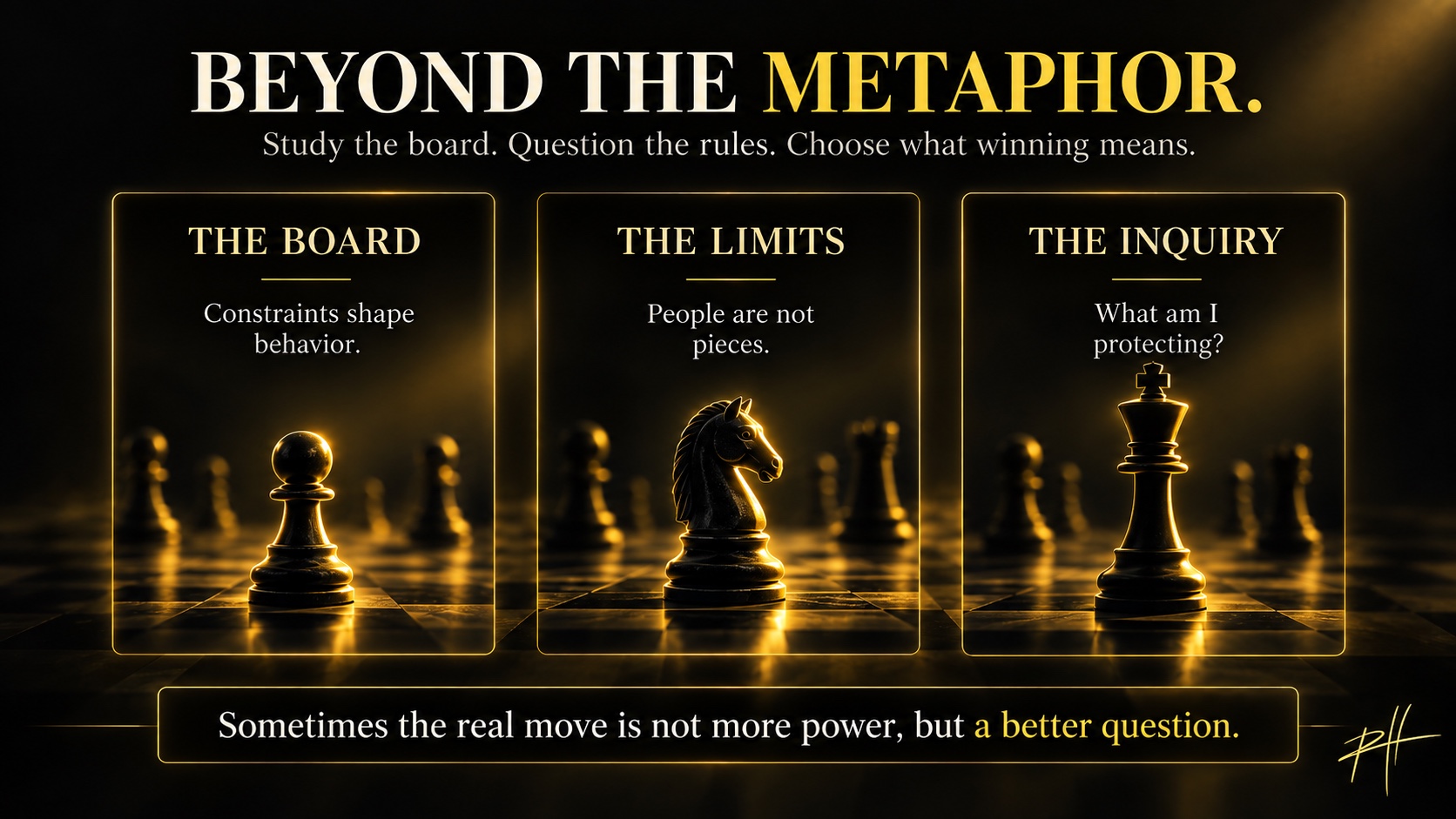
What piece am I playing here?
What is this system asking me to protect?
Did I choose its definition of winning?
Most of us spend our energy trying to become a more powerful piece. The more consequential move is noticing that you have organized your life around protecting a king you never chose.